


Redefining Japan’s Energy Future: Renewables Take the Lead, Nuclear Power Back in the Spotlight
In this week’s newsletter, explore Japan’s bold new energy blueprint aiming to position renewables at the forefront while rekindling nuclear power’s role.

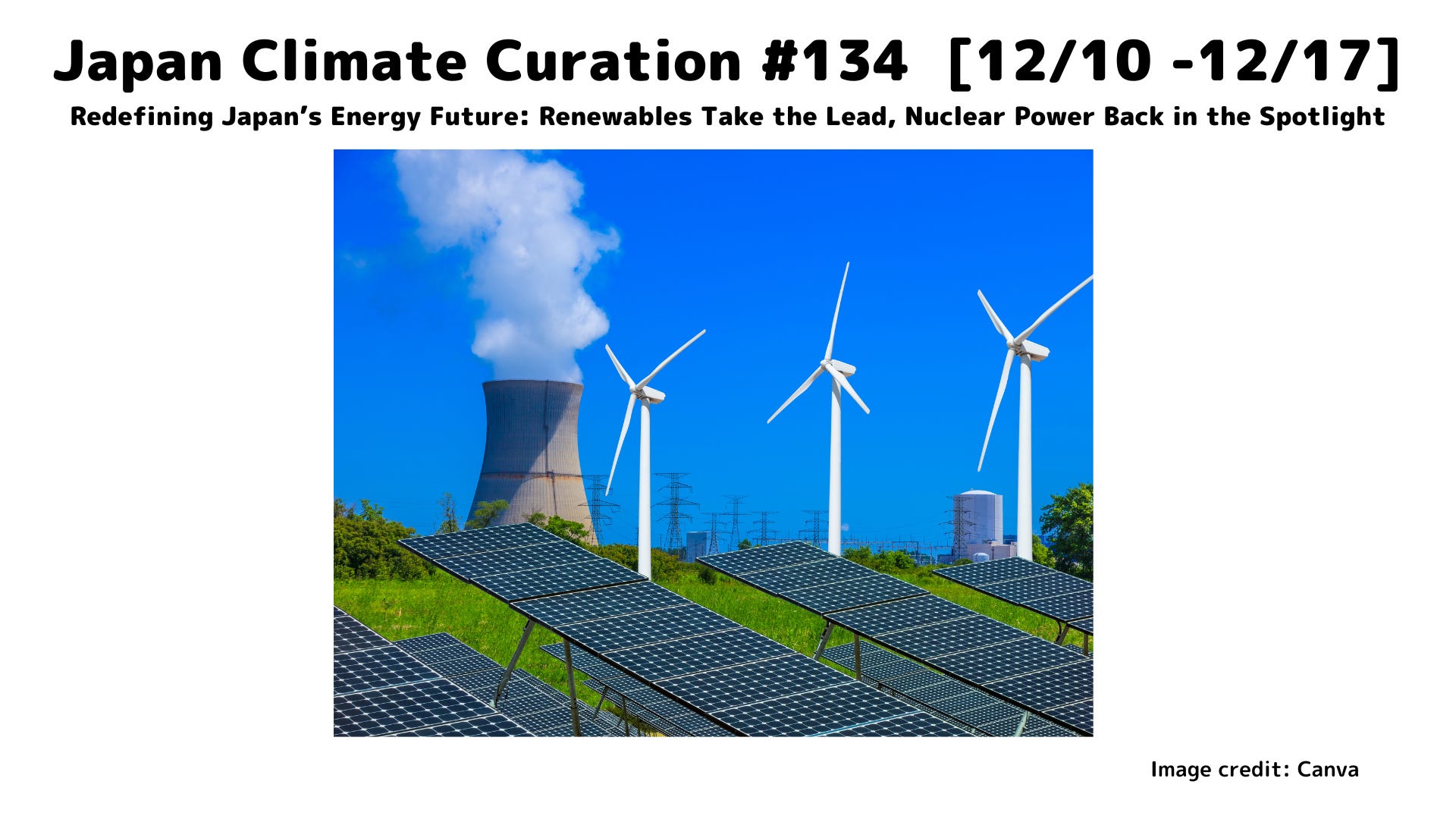
*Editor’s note: This article was originally published on 12/18/2024 on Linkedin.
Welcome! I'm Hiroyasu Ichikawa, ichi, and this is issue 134 of the "Japan Climate Curation" newsletter📬, which has been curating Japan-related climate news content every week since spring 2022, with over 380 subscribers [ more than 2,640 on Linedin]. You can subscribe by clicking on the Linkedin page or the form below.
I hope you find the articles below beneficial for reading (or skimming)!
Found this week's news insights valuable? Please give it a quick "like" or "share" on LinkedIn – you never know who else in your network might benefit from staying in the loop on Japan's climate scene🙂🙇
*Disclaimer: Generative AI tools such as Claude Sonet 3.5 has been used for summary and translation assistance 🙂
In this week’s newsletter, explore Japan’s bold new energy blueprint aiming to position renewables at the forefront while rekindling nuclear power’s role. Delve into the heated debate over 60% vs. 66% greenhouse gas reduction targets and discover the economic risks of unchecked climate change. You’ll also see how local innovations, such as producing drinking water from the air, demonstrate resilience and resourcefulness in the face of uncertainty.
[🇯🇵📰👀Japan Climate News Headlines]
[🇯🇵📰👀Japan Climate News Headlines]
【1】Making Renewable Energy the 'Primary Power Source' While Maximizing Nuclear Power Use [12/17 NHK]
The Japanese government has unveiled a draft of its new Basic Energy Plan, marking a significant shift in energy policy by making renewable energy the primary power source while maximizing nuclear power usage. The plan targets 40-50% renewable energy, 20% nuclear power, and 30-40% thermal power by 2040, dropping previous language about reducing nuclear dependence.
The government projects that electricity demand will increase by up to 20% by 2040, driven by AI adoption and digitalization. The plan emphasizes decarbonization and energy security, with cost projections showing nuclear power becoming more economical than LNG by 2040, though critics question these calculations.
The plan has drawn mixed reactions, particularly from Fukushima residents. While some accept nuclear power as necessary for energy security, others express strong opposition. The plan faces practical challenges, including that only 14 of 33 existing nuclear reactors are operational, making the 20% nuclear target challenging to achieve without new construction.
【2】Japan's draft climate strategy spurs calls for bolder cuts in carbon emissions [12/18 Reuters]
Japan's draft proposal for a 60% carbon emission reduction target by 2035 has sparked controversy, with experts and political allies calling for deeper cuts.
Japan's environmental policies attract global attention as the world's fifth-largest carbon emitter and major fossil fuel consumer.
The proposed target falls short of the IPCC's recommended 66% reduction to limit global warming to 1.5°C. The ruling coalition partner, Komeito, supports the stricter 66% target. Meanwhile, Japan aims to double renewable energy to 50% by 2040, though critics argue that the plan lacks concrete steps to phase out coal power.
【3】Japan targets 40-50% power supply from renewables by 2040 [12/14 Reuters]
Renewable energy target set at 40-50% of power supply by 2040, up from 22.9% in 2023
Nuclear power to maintain 20% share, with plans for next-generation reactors
Thermal power to decrease to 30-40% by 2040 from current 68.6%
Electricity demand is projected to rise 12-22% by 2040
Policy balances decarbonization with energy security concerns
Long-term LNG contracts are emphasized as transition fuel
【4】Japan’s Ruling Bloc Divided on Nuclear Power Use in New Energy Plan - Komeito Wants Less N-Power Use, LDP Pushes for More [12/18 The Japan News(The Yomiuri Shimbun)]
Strategic Energy Plan draft removes commitment to reduce nuclear power dependence
The new policy aims to maximize both renewable and nuclear energy use
LDP and Komeito are divided over nuclear power expansion
Current nuclear power generation is at 8.5%, down from 30% pre-2011
Komeito reluctantly accepted provisions for new reactor construction despite initial opposition
Democratic Party For the People(DPFP)'s support for nuclear power influenced the policy shift
【5】Climate Damage and Physical Impacts Likely to Wipe Out USD 9.2 trillion from Japan’s Economy if Current Global Policy Trajectories Continue [12/17 AIGCC(Asia Investor Group on Climate Change)]
Japan faces a potential 10% annual GDP loss (JPY 952 trillion) by 2050 under current climate policies
Seven of Japan's top 10 trading partners are in climate-vulnerable Asian regions
Transition to Net Zero could generate JPY 13.6 trillion annually by 2050
Japan is experiencing increasing climate-related damages (typhoons, floods, landslides)
Economic experts urge stronger emissions targets and renewable energy adoption
【6】Government Energy Policy Council: Are All Members Pro-Nuclear? [12/17 The Mainichi Shimbun]
Japan's Energy Basic Plan revision process is raising concerns about the composition of its advisory committee, which appears dominated by pro-nuclear members.
The 16-member committee, including business leaders and nuclear experts, has strongly supported nuclear power expansion, with only two members expressing cautious views.
Former committee member Takeo Kikkawa criticizes the imbalance, noting it's skewed towards industry demands.
Ministry officials acknowledge the challenge of selecting a balanced membership, citing difficulties in finding constructive criticism and the need to avoid problematic appointments that could affect policy implementation.
【7】Honda-Nissan merger talks mark Japan Inc’s new consolidate-to-survive mood -Carmakers face problems of Chinese competition, a shrinking domestic market, and the threat of tariffs [12/18 Financial Times]
Honda and Nissan are in merger talks to create the world's third-largest automaker, responding to multiple industry challenges. Both companies have seen significant sales declines over the past decade while facing intense competition from Chinese EV manufacturers like BYD.
The potential merger reflects broader pressures on Japanese industry, including rising Chinese competition, unpredictable US trade policies, and domestic economic changes.
This consolidation could trigger similar moves across Japanese industries. The merger would help both companies address challenges in EV technology, US market presence, and economies of scale while adapting to Japan's changing labor market.
【8】Honda and Nissan Say They Are Exploring Merger Possible combination comes after struggles for both automakers in China and a downturn for Nissan in the U.S. [12/18 Wall Street Journal]
Honda and Nissan confirm merger exploration
The combined entity would be the world's third-largest automaker.
Both companies are struggling in the Chinese EV market.
Nissan is planning to cut 9,000 jobs and reduce production capacity.
Nissan shares rose 23.7%, while Honda's fell 3% on the announcement
Honda's market cap is four times larger than Nissan's
Combined annual sales would be around 7.4 million vehicles (4M Honda, 3.4M Nissan)
【9】Japanese study links heavy Hokkaido snowfall in 2021 to climate change [12/18 The Japan Times]
Global warming increased Hokkaido's December 2021 snowfall by 10-20%
A two-stage weather process influenced by climate change caused record snow
The study used machine learning and climate simulation databases
24-hour snow accumulation exceeded 50cm in major cities
Research demonstrates that climate change can intensify specific snow events
Findings contribute to the "event attribution" climate science field
Methods can be applied to analyze extreme weather events globally
【10】Japan city aims to cut CO2 emissions by generating water from air [12/17 NHK World]
Tomioka City in Gunma Prefecture has launched an environmental initiative testing water dispensers that generate drinking water from atmospheric moisture.
The city has installed five units at public facilities, each producing 33 liters of drinking water daily. The one-year trial aims to reduce carbon dioxide emissions while promoting the use of reusable bottles. The Tokyo-based developer's technology can also process river water, producing up to 600 liters daily through special filtration. The project serves two purposes: environmental conservation and potential disaster preparedness.
📬That's all for this week! Thank you for reading(or skimming) 🙇. I hope you will have a wonderful week ahead!
Found this week's news insights valuable? Please give it a quick "like" or "share" on LinkedIn – you never know who else in your network might benefit from staying in the loop on Japan's climate scene🙂🙇
The "Climate Curation" newsletter in 🇯🇵Japanese (every Saturday) is available on Linkedin and Substack.
Please feel free to contact me via email: hiroyasu.ichikawa [@]socialcompany.org, f you have any research/consulting needs for your business or just for a coffee chat☕.
My personal Twitter(X) account (in 🇯🇵Japanese) @SocialCompany
BlueSky account(English): socialcompany.bsky.social]
ichi (Hiroyasu Ichikawa)