
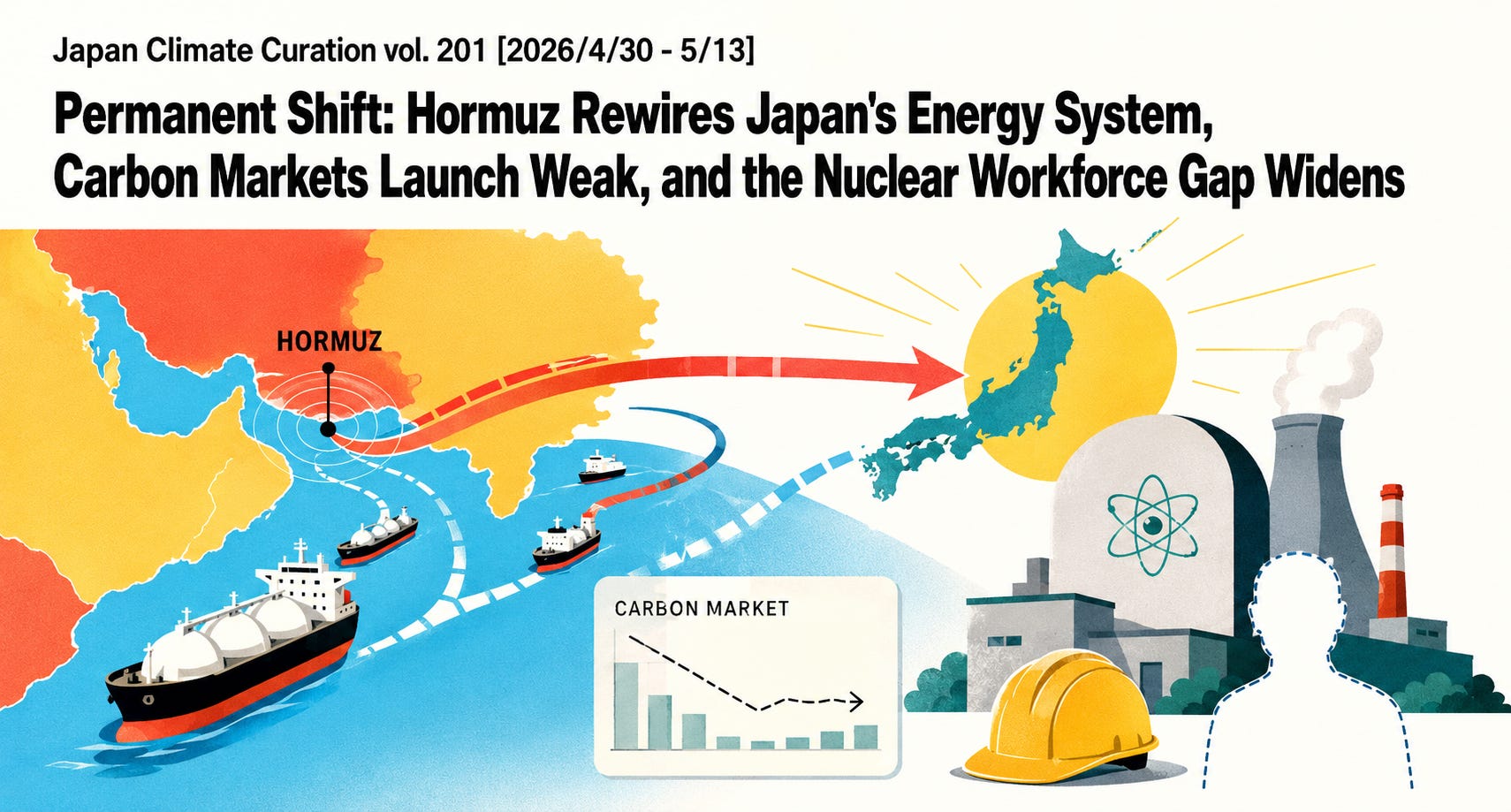
Vol.201 : Structural Breaks: Idemitsu Signals a Permanent Crude Shift, GX-ETS Launches Toothless, and Rokkasho Faces Its 28th Delay
Golden Week paused the newsletter — not the news. The past two weeks have been packed with major developments across the energy transition landscape, and this issue covers many of them :)

*Editor’s note: This article was originally published on 5/13/2026 on Linkedin.
Welcome to issue 201 of Japan Climate Curation! 📬 I’m Hiroyasu Ichikawa (ichi), curating Japan’s climate news weekly since 2022 for 540+ subscribers on this Substack & [3,170+ on LinkedIn].
🎧 Audio versions available: English 🇺🇸 | Japanese 🇯🇵
Found this valuable? A quick like or share helps others stay informed. 🙂
Disclaimer: Generative AI tools (Claude, ChatGPT, NotebookLM) have been used for summary and translation assistance. 🙂
[🇯🇵📰👀Japan Climate News Headlines]*Missed last issue? Click here to catch up
🛳️ Idemitsu Expects Hormuz Crisis to Ease by July, But Flags Permanent Shift in Crude Procurement [Nikkei Asia]
🛁 Iran War Reaches Japan’s Bathhouses — and the Elderly Who Depend on Them [The New York Times]
☢️ Japan’s Nuclear Fuel Reprocessing Plant Faces Yet Another Delay [The Japan Times]
⚙️ Japan’s Nuclear Industry Races to Rebuild Its Workforce Before Demand Peaks [Nikkei Asia]
💹 Japan’s Mandatory Carbon Market Is Live — But Critics Say the Price Is Too Low to Matter [Climate & Capital Media]
🔍 Japan’s Transition Bond Market Finances Gas Projects That Barely Cut Emissions [Green Central Banking]
⚡ Japan’s Hydrogen and Ammonia Push Is Industrial Policy in Climate Clothing [East Asia Forum]
🌏 Japan’s Clean Energy Investment Surges 44% to $39 Billion as Global Decarbonisation Hits Record High [Nikkei Asia]
🏙️ Japan’s AI Data Centre Boom Collides With Urban Communities and Outdated Building Codes [Financial Times]
🚗 China’s Chery Teams Up With Autobacs to Break Into Japan’s EV Market by 2027 [Nikkei Asia]
【1】🛳️ Idemitsu Expects Hormuz Crisis to Ease by July, But Flags Permanent Shift in Crude Procurement [05/12 Nikkei Asia]
Idemitsu Kosan is forecasting a Hormuz reopening from July, with oil prices at ~$80/barrel through December before easing to $65 in early 2027. But the more significant signal is structural: CFO Sakata stated that Middle East crude procurement strategies will not revert to pre-crisis levels, confirming a permanent shift in Japan’s refining supply chains regardless of how the conflict resolves.
💡 Insight:
Idemitsu’s July timeline is a market signal, not just corporate planning.
“Procurement strategies will not go back” is the most consequential line.
【2】🛁 Iran War Reaches Japan’s Bathhouses — and the Elderly Who Depend on Them [05/02 The New York Times]
Japan’s sento — traditional public bathhouses serving as the primary social lifeline for isolated elderly — are facing a survival crisis as the Hormuz conflict drives fuel costs up 50%. With entry fees capped at ~¥500 by prefectural governments and roughly one-fifth of operators already cutting hours, the industry warns the energy crisis risks permanently accelerating a decades-long decline.
💡 Insight:
The sento crisis is the most human-scale illustration of Japan’s Hormuz exposure.
The “irreversible decline” framing is the policy signal.
【3】☢️ Japan’s Nuclear Fuel Reprocessing Plant Faces Yet Another Delay [05/10 The Japan Times]
Japan Nuclear Fuel’s Rokkasho reprocessing plant — delayed 27 times since its 1993 groundbreaking — faces an almost certain 28th postponement. With the NRA’s detailed design review still unresolved and questions lingering over the vitrification furnace, the March 2026 deadline looks untenable despite the government’s official stance that it remains unchanged.
💡 Insight: Rokkasho is the linchpin of Japan’s nuclear fuel cycle strategy — continued delay compounds pressure on interim spent-fuel storage capacity at reactor sites, with direct implications for the economics and policy viability of nuclear restarts including Kashiwazaki-Kariwa.
【4】⚙️ Japan’s Nuclear Industry Races to Rebuild Its Workforce Before Demand Peaks [05/07 Nikkei Asia]
IHI, Mitsubishi Heavy, and Hitachi are deploying VR and camera-equipped welding masks to compress nuclear workforce training timelines — from up to a decade down to one or two years. With experienced staff depleted after a post-Fukushima construction freeze and Japan targeting 20% nuclear power by 2040, a widening skills gap now threatens to cap the industry’s recovery before demand even peaks.
💡 Insight:
The workforce bottleneck is structural, not cyclical.
Supply chain ambitions extend well beyond Japan.
【5】💹 Japan’s Mandatory Carbon Market Is Live — But Critics Say the Price Is Too Low to Matter [05/06 Climate & Capital Media]
Japan’s mandatory GX-ETS launched in April, covering emitters releasing over 100,000 tons of GHG annually. With a price ceiling of just ¥4,300/ton (~$30) — a third of EU ETS levels — and no hard emissions cap for the first five years, the system is widely seen as too weak to shift corporate behaviour. Policy design was dominated by industry associations like the Japan Iron and Steel Federation, with climate-aligned groups largely sidelined. EU CBAM pricing is expected to reach ¥8,000–14,000/ton, meaning Japanese exporters relying on GX-ETS compliance alone face a significant and growing carbon cost gap in European markets.
💡 Insight:
The CBAM gap is the most concrete near-term business risk.
METI’s process design is the structural constraint.
【6】🔍 Japan’s Transition Bond Market Finances Gas Projects That Barely Cut Emissions [05/06 Green Central Banking]
Japan issues 76% of the world’s transition bonds, but a new Energy Shift Institute analysis finds that most proceeds fund gas-to-gas plant replacements delivering only marginal emission cuts — a structural “efficiency paradox.” The Climate Bonds Initiative has declined to certify subsequent GX bonds, raising credibility questions with direct implications for Asian transition finance standards.
💡 Insight: The CBI (Climate Bonds Initiative) certification withdrawal is the most material signal.
【7】⚡ Japan’s Hydrogen and Ammonia Push Is Industrial Policy in Climate Clothing [04/29 East Asia Forum]
Japan’s hydrogen and ammonia push is driven more by industrial policy logic than decarbonisation effectiveness — the technologies will contribute just 1% of power generation by the 2030s while renewables are already at 23% and rising. The 7th Strategic Energy Plan locks in thermal infrastructure and keeps coal alive via co-firing, with Keidanren incumbents as the primary beneficiaries.
💡 Insight:
The 1% vs. 23% contrast is the headline number.
Keidanren’s incumbents are the structural explanation.
【8】🌏 Japan’s Clean Energy Investment Surges 44% to $39 Billion as Global Decarbonisation Hits Record High [05/08 Nikkei Asia]
Japan posted one of the sharpest investment increases among major economies in 2025, with decarbonisation spending surging 44% to $39 billion — driven by Nippon Steel’s ¥868.7 billion commitment to electric arc furnace transition and Orix’s push into green hydrogen and next-generation energy. The jump came as global clean energy investment rose 8% to a record $2.3 trillion, with Asia-Pacific accounting for 47% of the total. For Japan, the figures suggest private capital is moving ahead of policy frameworks: corporate balance sheets are being deployed on decarbonisation even as GX-ETS prices remain too low to compel action and transition bond credibility faces scrutiny.
💡 Insight:
Japan’s 44% investment surge signals a private-capital-led transition.
Japan’s data centre energy demand is becoming a renewable investment driver.
【9】🏙️ Japan’s AI Data Centre Boom Collides With Urban Communities and Outdated Building Codes [05/02 Financial Times]
Japan’s AI data centre expansion — a $23bn market projected to grow 50% by 2030 — is generating sharp residential backlash in dense urban areas. A structural flaw lies at the root: Japan classifies data centres as offices, exempting them from industrial regulations, while bubble-era zoning rules leave communities with little recourse against deep-pocketed developers.
💡 Insight:
The regulatory gap is a live investment risk.
The Fukushima mega-solar parallel is a warning sign — locals and officials are already drawing comparisons to the post-2011 solar overdevelopment that eventually prompted a government crackdown.
【10】🚗 China’s Chery Teams Up With Autobacs to Break Into Japan’s EV Market by 2027 [05/11 Nikkei Asia]
Chery Automobile and Autobacs Seven are launching a joint EV brand in Japan in 2027, leveraging Autobacs’ 1,200-store network to solve the distribution bottleneck that has constrained BYD’s Japan rollout. With four models planned by 2029 at mass-market pricing and Q1 2026 EV penetration crossing 2.5% for the first time, the venture targets Japan’s largely untapped EV growth potential.
💡 Insight:
The Autobacs distribution play is the strategic differentiator.
Japan’s EV subsidy gap is a structural headwind for Chinese entrants.
📬 That’s a wrap for this week! Thank you for reading.
Found this useful? A quick like, comment, or share on LinkedIn helps more people discover Japan’s climate developments. 🙏
📩 Stay connected:
🇯🇵 Japanese edition: [Climate Curation](LinkedIn / theLetter link) — every Saturday
🐦 X (Japanese): @SocialCompany
🦋 Bluesky (English): socialcompany.bsky.social
💼 Work with me: Looking for research, consulting, or market insights on Japan’s climate/energy sector? Let’s talk. 📧 hiroyasu.ichikawa[@]socialcompany.org | ☕ Coffee chats welcome!